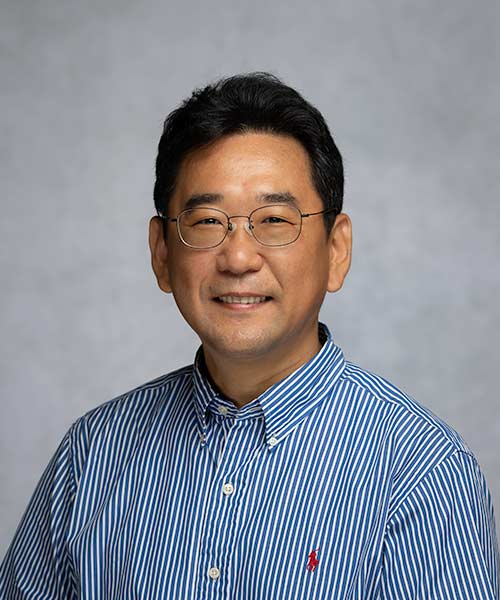

Dr. Chang Hoon Lee
Department
School of Health Sciences
Role: Faculty
Campus: Springfield
Postal mail
Missouri State University
School of Health Sciences
901 S. National Ave.
Springfield,
MO
65897
Details
Education
- Ph.D., Institute for Cell and Molecular Biology, 2011, The University of Texas at Austin
Advisor: R. Adron Harris, Ph.D.
Dissertation: Splicing of human GABAB receptor subunit 1 (GABAB1) in non-alcoholic and alcoholic brains - M.S., Interdisciplinary Program in Brain Science, 2004, Seoul National University
Advisor: Bong-Kiun Kaang, Ph.D.
Thesis: Molecular cloning and characterization of phosphodiesterase (apPDE) in Aplysis kurodai - B.S., Biological Sciences, 2002, Seoul National University
Teaching
- BMS 521 / BMS 622 - Molecular Cell Biology
- BMS 520 / BMS 620 - Medical Cell Biology
Professional experience
- 2025 – present Assistant Professor
School of Health Sciences, Biomedical Sciences Program, Missouri State University - 2022 – 2025 Instructor
Department of Neuroscience, the University of Texas Southwestern Medical Center
Advisor: Joseph S. Takahashi, Ph.D. - 2017 – 2022 Research Scientist
Department of Neuroscience, the University of Texas Southwestern Medical Center
Advisor: Joseph S. Takahashi, Ph.D. - 2012 – 2017 Postdoctoral Scholar
Department of Neurology, the University of California, Los Angeles
Advisor: Daniel H. Geschwind, M.D., Ph.D. - 2012 Next-Gen Sequencing Postdoc
Waggoner Center for Alcohol and Addiction Research, the University of Texas at Austin
Advisor: R. Adron Harris, Ph.D. - 2004 – 2005 Research Technician II
Department of Biochemistry and Molecular Biology, Baylor College of Medicine
Advisor: Francis T.F. Tsai, D.Phil.
Selected Publications
- Kim YE, Kim M, Kim S, Lee R, Ujihara Y, Marquez-Wilkins EM, Jiang YH, Yang E, Kim H, Lee C, Park C, Kim IH. (2025) Endothelial SHANK3 regulates tight junctions in the neonatal mouse blood-brain barrier through β-Catenin signaling. Nat Commun. 16(1):1407.
- Xu P, Shimomura K, Lee C, Gao X, Simpson EH, Huang G, Joseph CM, Kumar V, Ge WP, Pawlowski KS, Frye MD, Kourrich S, Kandel ER, Takahashi JS. (2022) A missense mutation in Kcnc3 causes hippocampal learning deficits in mice. Proc Natl Acad Sci U S A. 119 (31), e2204901119.
- Lee C, Kang EY, Gandal MJ, Eskin E, Geschwind DH. (2019) Profiling allele specific gene expression in brains from individuals with autism spectrum disorder reveals preferential minor allele usage. Nat Neurosci. 22(9):1521-1532.
- Berg JM, Lee C, Chen L, Galvan L, Cepeda C, Chen JY, Peñagarikano O, Stein JL, Li A, Oguro-Ando A, Miller JA, Vashisht AA, Starks ME, Kite EP, Tam E, Gdalyahu A, Al-Sharif NB, Burkett ZD, White SA, Fears SC, Levine MS, Wohlschlegel JA, Geschwind DH. (2015) JAKMIP1, a novel regulator of neuronal translation, modulates synaptic function and autistic-like behaviors in mouse. Neuron. 88(6):1173-1191.
- Lee C*, Mayfield RD, Harris RA. (2014) Altered gamma-aminobutyric acid type B receptor subunit 1 splicing in alcoholics. Biol Psychiatry. 75(10):765-773. (* Corresponding author)
- Lee C*, Harris RA, Wall JK, Mayfield RD, Wilke CO. (2013) RNaseIII and T4 Polynucleotide Kinase sequence biases and solutions during RNA-seq library construction. Biol Direct. 8(1):1-16. (* Corresponding author)
- Lee C*, Mayfield RD, Harris RA. (2010) Intron 4 containing novel GABAB1 isoforms impair GABAB receptor function. PLoS One. 5(11):e14044. (* Corresponding author)
- Park H, Lee JA, Lee C, Kim MJ, Chang DJ, Kim H, Lee SH, Lee YS, Kaang BK. (2005) An Aplysia type 4 phosphodiesterase homolog localizes at the presynaptic terminals of Aplysia neuron and regulates synaptic facilitation. J Neurosci. 25(39):9037-9045.
Research and professional interests
Dr. Chang Hoon Lee is interested in the neuronal mechanisms underlying autism spectrum disorder (ASD) by employing computational and neurobiological approaches to identify therapeutic targets. Currently, I am investigating its etiology in sleep and circadian rhythm through innovative multi-omics-based systems biology studies.
- Identifying orphan C/D box small nucleolar RNAs (snoRNAs) as therapeutic targets for autism spectrum disorder sleep disorder through multi-omics and EEG/EMG studies
- Identified a novel spatiotemporal transcriptome network in the brain and elucidated why many ASD patients have disrupted circadian rhythms and problems with sleep
- Elucidating the transcriptional mechanism in suprachiasmatic nucleus (SCN) as the central pacemaker of circadian rhythm via histone post-translational modification and transcriptome studies
- Elucidating the roles of miRNA in contributing the robust rhythmicity of the transcriptome in the SCN
- Identifying the optimal sleep deprivation model that does not increase stress level in mouse through biochemical and transcriptomic studies
Awards and honors
2022 Texas Society for Circadian Biology & Medicine (TSCBM) Poster Award (1st Place), TSCBM
2016 Elsevier Family Support Awards, the Cell Symposium: Big Questions in Neuroscience
2011 Bionet Award, Korean-American Biomedical Scientists Symposium
2010 Association of Korean Neuroscientists (AKN) Outstanding Research Award, AKN
2010 Professional Development Award, the University of Texas at Austin
2010 Jones Fellowships in Alcohol and Addiction Research Travel Award, the University of Texas at Austin
2002 – 2003 Merit Based Scholarships, Seoul National University
2000 – 2001 Merit Based Scholarships, Seoul National University
1999 Honors Diploma, Sprott-Shaw Community College
1995 Merit Based Scholarships, Seoul National University